How we build modern rare disease intelligence
Author
Patrick de Boer
Published
4 November 2026
Read time
6 min read
In the first article of our methodology series, we explain how we bring rare disease evidence together through a hybrid model: artificial intelligence (AI) to search widely, and human intelligence to judge what the evidence means. Our rare disease specialists verify every step and add the real-world insight that no publication holds. We also show how this approach keeps the evidence up to date and alerts you to signals that could affect your programme.
Why is rare disease intelligence so hard to bring together in Europe?
Evidence on a rare disease is scattered across thousands of sources in the EU's 27 member states, each with its own health system. Furthermore, each source offers only part of the picture. Natural history studies, registry reports, congress abstracts, national guidelines and trial records may each describe just a few dozen patients. They may also use different terms and capture different points in time.
The patients themselves are scattered too. Numbers per country are small, and care is organised very differently. Some countries have dedicated expert centres, others have only a few, and in some care is spread across many hospitals and physicians. With so few patients, disease-specific expertise outside the expert centres can be limited. Many patients also remain undiagnosed for years, because a rare disease is often not recognised by the first healthcare professional they see. The result is a long time to diagnosis and a patient population that published data only partly capture.
A medicine can be authorised for use across the EU, but access is decided country by country. Pricing and reimbursement remain national responsibilities, and each member state reaches its own conclusions about a medicine's added clinical value [1]. Joint clinical assessments will cover orphan medicines from 13 January 2028, but pricing and reimbursement decisions will remain national [1].
Health systems and HTA procedures differ, as do the ways patients are diagnosed, referred and treated. The centres and medical specialists involved along the patient journey, and the questions payers ask, vary too. For sponsors, the same medicine therefore takes a different route to patients in each country. Mapping those routes early takes evidence from each health system, covering both published data and local clinical practice.
Our hybrid model: AI for reach, human intelligence for judgement
Generative AI lets us carry out in-depth desk research far more widely than a team could by hand, in a fraction of the time. Finding more evidence is only half the task; the other half is seeing how the pieces fit together. That is where artificial and human intelligence work best in combination: the technology widens the search, and our rare disease experts steer it and judge what the evidence actually shows. We do not use general-purpose chatbots for this. Our approach is tailored to rare disease and built on the field's own references, such as Orphanet's knowledge base and the European Reference Networks.
From that foundation, we search fourteen source types in two groups (Figure 1): published and registered evidence, and the health system and care ecosystem around the patient. Together they give our experts both breadth and depth, so their time goes into assessing the evidence rather than finding it.
That assessment follows a clear division of roles. Everything we collect, including our own anonymised interviews and surveys, is screened with AI, which ranks, groups and drafts but never decides [4]. The decision always rests with people: experienced rare disease specialists, who judge which findings matter for the client or the disease area, in which countries, and with what confidence. Combining the two also brings out patterns and sentiments across sources that a manual review would easily miss.
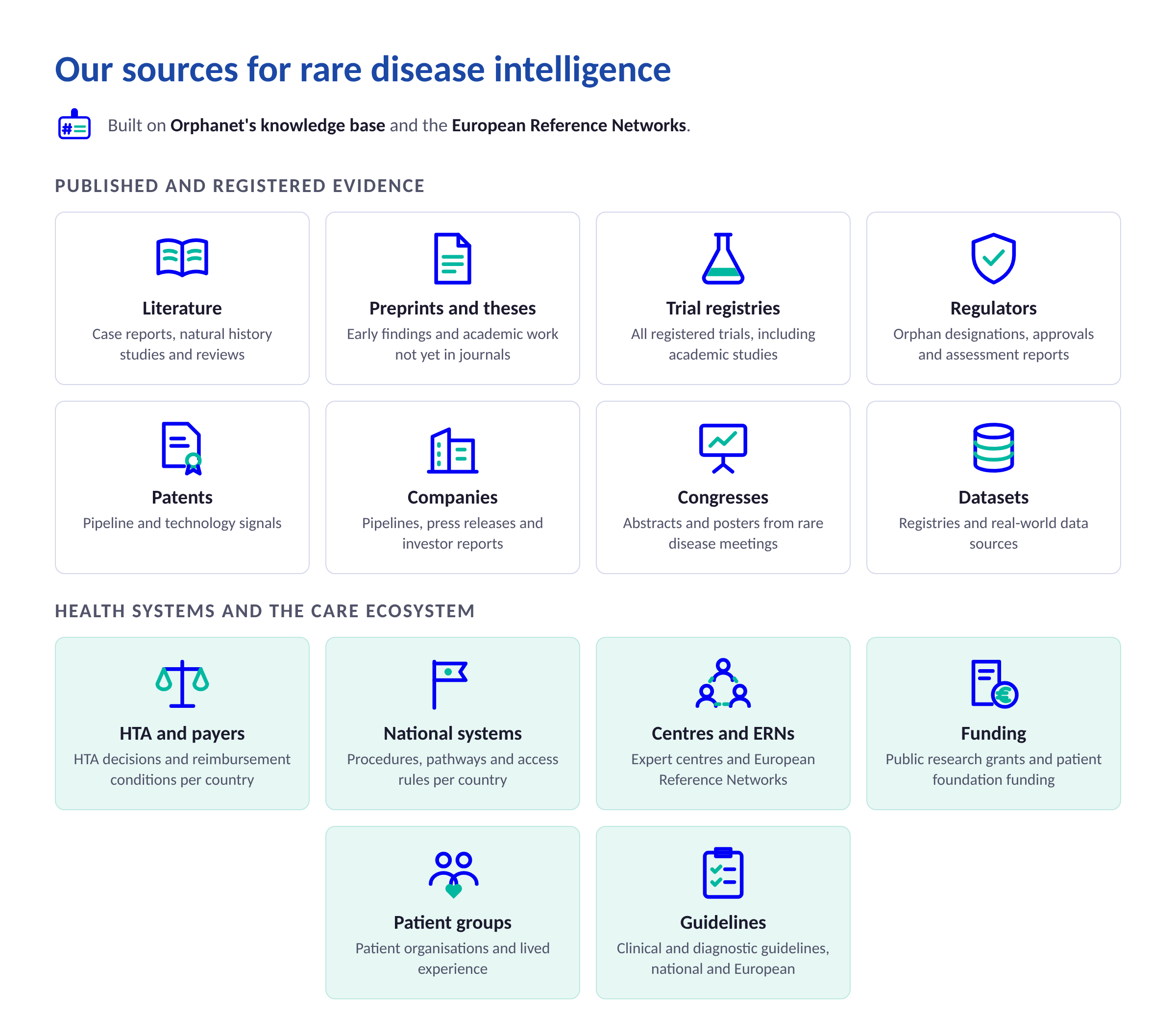
Figure 1. Fourteen source types, built on Orphanet's knowledge base and the European Reference Networks. AI-assisted search; every finding checked by an expert.
Good use of AI starts with its limits
Most people who have used generative AI have seen it happen: an answer that reads well, sounds confident and turns out to be wrong. These "hallucinations" are a key reason many teams in medical affairs and market access still hesitate to rely on AI. Regulators also take the risk seriously. The EMA advises anyone using large language models to check every output for accuracy and to ask for sources that support it [2]. In January 2026 the FDA and the EMA went further, with joint principles of good AI practice in drug development: expertise in both the technology and its field, documentation of data and decisions that is traceable and verifiable, and monitoring over time [3].
Our workflow is built on exactly these points. Every claim carries its own ID, links to a numbered source and is backed by an archived copy of that source [4]. An expert accepts or rejects every claim, and a named person signs off [4]. Claims are re-checked as the evidence moves, and every change is logged. A finding that cannot be traced to its source never reaches the client. For our clients, that means the speed of AI, combined with human expertise, without its main risk: evidence they can defend when a medical, market access or investment committee asks where a number comes from.
What the published evidence cannot tell you
For a published finding, that question has a clear answer. Many of the answers that shape a launch, however, have no published source at all. Some are numbers: how many patients are diagnosed, how they are segmented, and how many would be eligible for a trial or treatment. Some are local knowledge: how long a referral takes in a given country, whether a centre can actually deliver a new therapy (hospital readiness), and how treatment decisions are made, including the role of the patient alongside the treating specialist. And some are experience and sentiment: how patients, families and clinicians live with the disease, what they expect from a new treatment, and what drives or blocks its uptake. These answers sit with people, not in publications, and they often make or break a strategy or a launch. That is why we treat them as evidence too.
Treating them as evidence starts with real conversations with the people who know. Over many years in rare disease, our team has built trusted relationships with expert centres, clinicians, nurses and other healthcare professionals (HCPs), and patient organisations across Europe. We build a bridge to these networks and ask for their input through interviews, surveys and polls, in each market that matters for the decision. For the experts, it is a chance to share what they see in daily practice and help shape how new therapies reach their patients. For our clients, it means direct access to real-world expertise, rather than a database list of names.
Who the right people are is wider than it used to be. Medical affairs practice increasingly looks beyond individual key opinion leaders to the full network that shapes care [7]. In rare diseases, we see that network as families, patient advocacy groups, nurses, fundamental researchers and biomarker experts, alongside clinicians and payers. Each of them influences how patients are diagnosed, treated and supported, and each brings evidence that no publication holds. This ecosystem approach is what makes our picture of a market complete.
How do we keep it current and relevant for your programme?
A traditional landscape report costs time and money, and starts to age on the day it is delivered. That is why we maintain ours as a living evidence base, in which each claim has its own ID and source [4]. Because every claim stands on its own, it can be updated as soon as new evidence appears, such as a trial result, a new paper or a competitor's move, without rebuilding the report [4]. Those developments are monitored continuously, and each claim is re-checked by our experts at a cadence that fits its subject, with every change recorded in a change log [4]. When a change touches your programme, you receive a signal explaining what changed, which findings it affects and what it means for the decision ahead [5].
What does this look like in practice?
In a recent European landscape for Batten disease, the work ran to 458 traceable claims, drawn from 289 sources across 89 organisations, with more than 1,000 publications screened (illustrative figures, as shown on our About page) [6]. The desk research was complemented by interviews with industry, investor, clinical and research experts, and with patient representatives. Each claim can be followed back to its source and its version, and each can be revised as the field changes [4].
Related reading
Sources
4. Systemix Health. Home page: method, claim records and sign-off (page opened 4 November 2026).
5. Systemix Health. Rare disease landscaping: process steps (page opened 4 November 2026).