
Waskyra: how a charity took a dropped gene therapy to EU approval
Waskyra, the first gene therapy for Wiskott-Aldrich syndrome, reached European patients this year because a charity picked it up after two companies let it go. Last week the regulators who assessed it published their own account, and they want more small developers to come to the EMA early.
Author
Jochem Bossenbroek
Published
3 November 2026
Read time
3 min read
Waskyra, the first gene therapy for Wiskott-Aldrich syndrome, reached European patients this year because a charity picked it up after two companies let it go.
What did the regulators publish?
The paper appeared in Drug Discovery Today on 28 October. Its authors are assessors from the EMA and from the medicines agencies of France, Ireland and Austria, plus one academic from the University of Lisbon [1]. They walk through how the EU committees judged Waskyra (etuvetidigene autotemcel) and why the outcome was positive.
In their view, the approval shows that a small, non-profit applicant can get a gene therapy through the EU system with the agency's help. They advise others working on a therapy for a clear unmet need to talk to the EMA early [1]. The full paper is paywalled, so we worked from the abstract and from public EMA and developer documents.
Who is it for, and what did the trials show?
Waskyra is meant for patients from 6 months of age with Wiskott-Aldrich syndrome caused by a WAS gene mutation. They have to be candidates for a stem cell transplant who have no matching donor [2].
The approval rests on 27 patients. Ten children aged 1 to 9 took part in the main single-arm study, and another 17, aged 1 to 35, came from a second trial and an expanded access programme [2]. In the year before treatment, patients had on average 2.0 severe infections. Two to three years after treatment that figure was 0.12. Moderate and severe bleeds went from 2.0 a year to 0.16 over the same period [2].
The EMA's committee gave a positive opinion in November 2025. The FDA approved the therapy in December, and the European Commission granted EU authorisation on 9 January 2026 [2][3][4].
How did a charity end up as the applicant?
The work started at the San Raffaele Telethon Institute for Gene Therapy in Milan. GSK took a licence and in 2018 handed its rare disease gene therapies to Orchard Therapeutics. Orchard stopped the Wiskott-Aldrich programme when it restructured in 2022, and Fondazione Telethon took the rights back in 2024 [4]. The foundation says it is the first non-profit to take a gene therapy all the way through development [3].
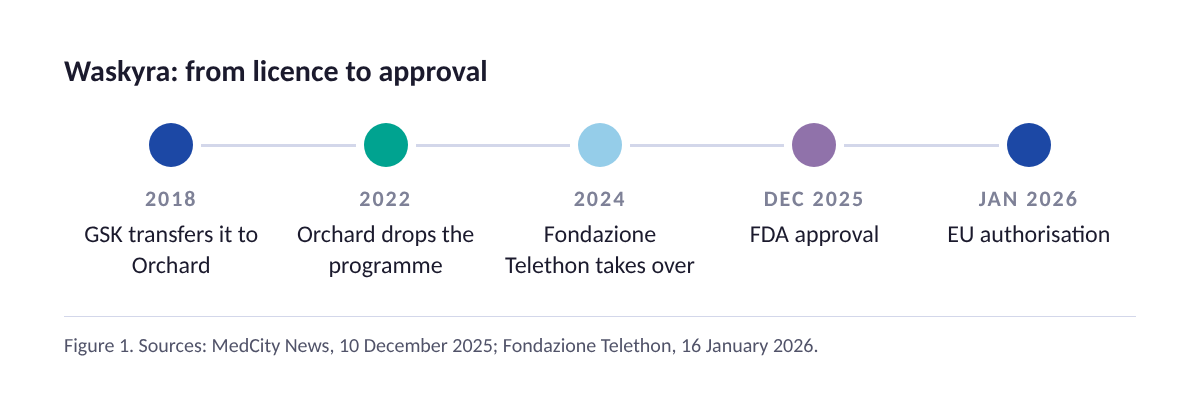
Along the way, the EMA included Waskyra in its pilot for academic and non-profit developers of advanced therapies. Developers in the pilot get extra guidance on EU requirements and lower fees for scientific advice, the marketing application and pre-approval inspections [2]. In the US, the approval also earned Telethon a rare paediatric disease priority review voucher [4].
Systemix view: what a shelved programme can still become
We take three things from this case.
First, companies drop rare disease programmes for many reasons, and portfolio choices are often among them. As long as someone keeps the data, the manufacturing know-how and the clinical network together, a parked programme can still reach patients.
Second, a small trial can be enough. Twenty-seven patients carried this approval because the effect was large and was measured in the same people before and after treatment.
Third, approval does not settle access. Each member state still decides on price and reimbursement [2], and a foundation has to convince payers just as a company does, usually with fewer people.
If your foundation or academic group holds a promising programme, contact the EMA pilot early, and start building the evidence payers will want while you prepare the regulatory file.